Artificial Intelligence
Our Products
Products
Our product portfolio covers the operating layers where AI delivers measurable return: cloud infrastructure, revenue operations, enterprise decision-making, software engineering, industrial assets, cybersecurity, and facility access. These are established platforms with defined feature sets, deployment paths, and support models — not concepts. Each is supported by Eficens Solutions technology, giving customers the backing of a mature engineering organization behind every deployment.

DiscoverCloud
DiscoverCloud is our AI-enabled, AWS-powered cloud infrastructure and management platform, built for organizations that need to move workloads to the cloud and then run them well. The platform brings migration, modernization, and ongoing infrastructure management under a single operational layer, with AI applied to the parts of cloud operations that traditionally consume the most engineering time — capacity decisions, configuration management, and cost control. DiscoverCloud includes a family of purpose-built components: Trekora, Traverse, SAPAssist, and our LLMx model-routing solutions, which allow customers to select and switch between large language models rather than committing to a single vendor. For organizations weighing a cloud migration or struggling with an environment that has grown faster than the team managing it, DiscoverCloud provides both the transition path and the long-term operating model.

Wyra
Wyra is an agentic AI presales platform that automates end-to-end B2B outbound prospecting. Rather than acting as a single-function tool bolted onto an existing sales stack, Wyra runs the full top-of-funnel sequence: continuously enriching prospect data, orchestrating outreach across multiple channels, and sequencing contact through AI-driven timing and messaging decisions. The platform is designed for revenue teams that need pipeline coverage beyond what headcount allows, and for organizations entering new markets where prospect research and qualification would otherwise absorb months of business development capacity. Wyra operates as an autonomous layer within the sales function, escalating to human sellers at the point where a conversation becomes qualified.

MetaBrain
MetaBrain is an enterprise AI solution embedded directly in the SAP Business Technology Platform ecosystem, designed to strengthen strategic decision-making for organizations running SAP as their operational backbone. Because it operates inside the BTP environment rather than alongside it, MetaBrain works against live enterprise data without the extraction, duplication, and reconciliation overhead that typically separates an analytics initiative from the systems it is meant to inform. The result is decision support grounded in the same records that drive operations. MetaBrain suits enterprises that have made a significant SAP investment and want AI capability that respects and extends that architecture rather than competing with it.

cognEfi
cognEfi is a cognitive AI solution for software development that improves engineering productivity and streamlines the software development lifecycle. It applies AI across the phases where delivery organizations lose the most time — requirements interpretation, code generation and review, testing, and release preparation — with the goal of increasing throughput without expanding the team. cognEfi is built for engineering leaders under pressure to ship more with a fixed roster, and for organizations carrying technical debt that slows every subsequent release. It functions as an accelerant to an existing development practice rather than a replacement for engineering judgment.

Innvendt
Innvendt is a full-stack industrial IoT platform for organizations that operate physical assets and need visibility into their condition, use, and safety. The platform combines AssetVision for asset monitoring and tracking, Earth R and E5 for environmental and energy management, and smart LOTO for digitally governed lockout/tagout procedures. Innvendt connects instrumentation, analytics, and operational workflow into a single system, so that asset data drives maintenance and safety action instead of accumulating in isolated historians. It is built for manufacturing, energy, utility, and heavy industrial environments where equipment reliability and worker safety carry direct financial and regulatory consequence.

VisiQ
VisiQ is an enterprise visitor management system that governs who enters a facility, when, and under what authorization. The platform provides touchless visitor entry, integrated smart LOTO controls, and configurable approval workflows, replacing paper logs and disconnected badge systems with a single auditable record of site access. VisiQ is designed for organizations where physical access is a genuine security and compliance control rather than a courtesy — regulated manufacturing sites, research facilities, healthcare campuses, and secured corporate environments — and where visitor records must withstand audit scrutiny.
Solutions
Custom Solutions
Not every problem maps to a product. A significant share of our work begins with a customer requirement that has no commercial equivalent — a mission constraint, a data environment, a regulatory boundary, or an operational reality that rules out anything off the shelf. Our custom solutions practice exists for that work.
We engineer AI systems from the ground up across the full technical stack. Our capabilities include:
AI and machine learning enablement
We design, train, and deploy models against customer-specific data, including generative AI, cognitive automation, and traditional predictive and classification approaches. Where general-purpose models are insufficient, we build and tune customized large language models fitted to a customer’s domain, vocabulary, and accuracy requirements.
Custom engagements typically begin with a discovery phase that defines the problem precisely, followed by rapid prototyping to prove the approach before committing to full build. We are equally comfortable operating as a prime, as a subcontractor, or as the technical partner inside a larger consortium.
Agentic AI and orchestration
We build autonomous agent systems that carry work end to end rather than answering a single query — agents that monitor, retrieve, reason, act, and escalate, operating within defined control planes and governance boundaries.
Data architecture for AI
AI systems fail on data long before they fail on models. We build the underlying layer: data fabrics, vector databases, retrieval-augmented generation pipelines, semantic data models, and memory-centric architectures that make enterprise data usable by AI systems at scale.
Cybersecurity and zero trust engineering
We deliver security architecture, assessment, and build services spanning cloud and infrastructure security, data protection, digital identity, platform security, and continuous zero trust implementation — including AI-driven threat detection, threat hunting, and security operations design.
Cloud and edge deployment
We architect for the environment the mission requires, whether that is multi-cloud, on-premises, air-gapped, or distributed to the edge, and we handle the migration and modernization work required to get there.
Immersive and physical-digital integration
Where the operating environment is physical, we integrate AI with AR/XR, computer vision, digital twin, and IoT systems to put intelligence in the hands of frontline personnel — in industrial automation, defense, healthcare, and field operations.
Custom engagements typically begin with a discovery phase that defines the problem precisely, followed by rapid prototyping to prove the approach before committing to full build. We are equally comfortable operating as a prime, as a subcontractor, or as the technical partner inside a larger consortium.
Defense Logistics Agency SBIR Submission
In July 2026, DexTech submitted a proposal under a Defense Logistics Agency Small Business Innovation Research topic addressing cybersecurity capability for the agency’s logistics and enterprise systems. The effort is representative of how our custom practice works.
DLA operates one of the largest and most interconnected logistics enterprises in the world, and its systems environment carries a corresponding attack surface — a mix of enterprise applications, supplier-facing interfaces, and legacy components that no single commercial security product was designed to cover. Our proposed approach applied AI-driven detection and quantitative risk prioritization to that environment, drawing on the same underlying technology that powers our commercial security work but re-architected against defense requirements: the data sensitivity, the accreditation path, the operating constraints, and the sustainment model that federal deployment demands.
The proposal was developed by an internal team combining federal capture expertise with the AI and cybersecurity engineering staff who would execute the work, and was assembled to DLA’s full volume structure and compliance requirements. It illustrates the pattern we bring to custom work generally: a real mission problem, a technical approach adapted rather than repackaged, and a delivery team that can carry the solution from proposal through deployment.
DexFlow
The Concept
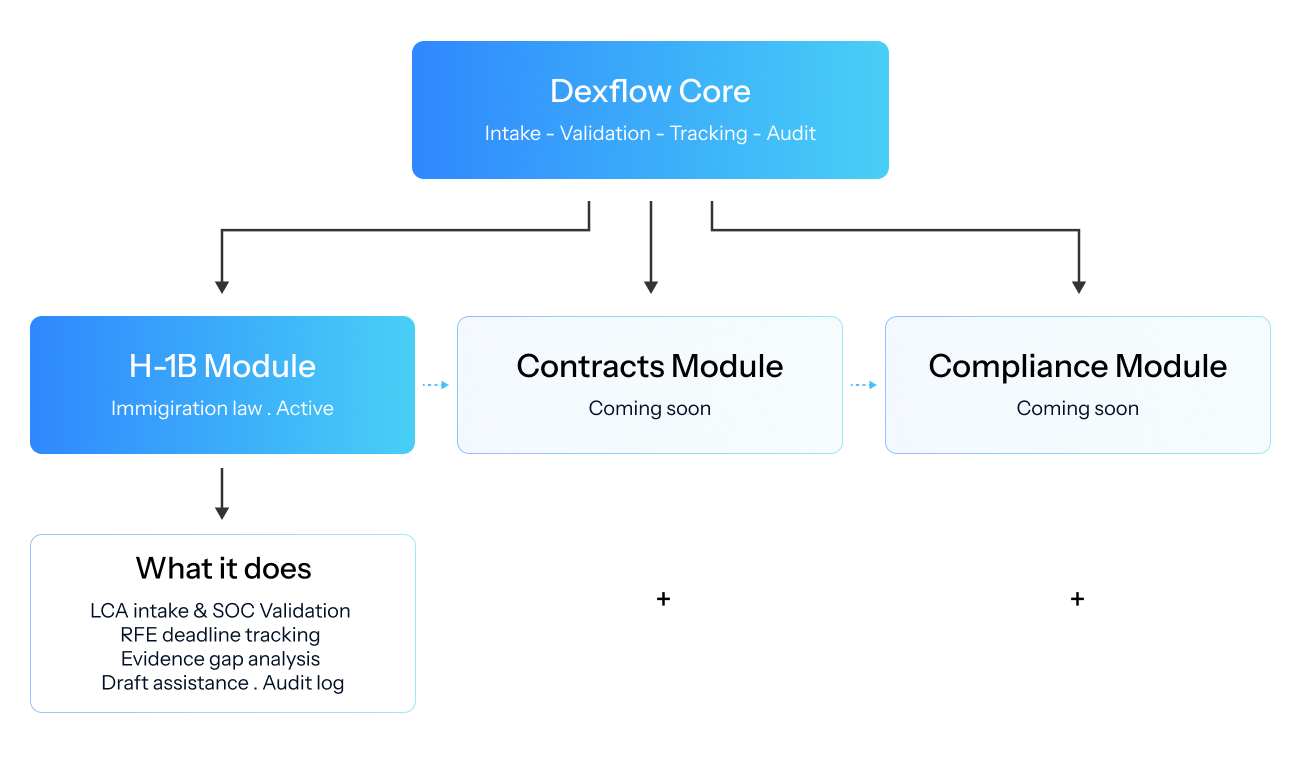
DexFlow is a purpose-built platform for immigration legal operations — the high-volume, deadline-driven, compliance-critical work that immigration practices and corporate legal teams perform every day and that generic case management software has never served well.
Immigration legal work has a specific shape. It is procedural rather than adversarial. It runs on federal filing systems with unforgiving deadlines. Its accuracy requirements are absolute, because a single inconsistent data field can trigger a Request for Evidence that costs weeks of attorney time and puts a beneficiary’s status at risk. And it generates a documentation trail that must survive Department of Labor audit years after the fact. Practices manage this today with spreadsheets, shared drives, calendar reminders, and institutional memory — a stack that works until volume grows or a key person leaves.
DexFlow brings that work into a single system. The platform covers Labor Condition Application filing and status tracking through a visible pipeline, Request for Evidence tracking with deadline management and ownership assignment, prevailing wage lookup against SOC and O*NET data, and reporting across the full caseload. The design intent is that a practice manager can see the state of every active matter at a glance, and that no deadline depends on someone remembering it.
The platform’s Phase 1 architecture reflects a deliberate technical decision. Our discovery work established that the historical data volume available at launch would not support reliable machine learning-driven prediction, so rather than promise capability the data could not sustain, we built Phase 1 on rule-based validation — which catches filing errors deterministically and explains why — combined with LLM-assisted drafting, which accelerates document preparation while keeping the attorney in control of the output. Predictive capability enters the roadmap when the platform’s own operating data can genuinely support it.
DexFlow is currently in active development and moving through its build phase toward initial deployment.
Measure Success
How We Measure Success
DexFlow’s performance is evaluated against operational outcomes that a practice can feel, not feature counts. The following indicators define what the platform is built to move:
Filing cycle time
Elapsed time from case intake to submitted filing. The core efficiency measure, and the one that determines how much volume a given team can carry.
First-pass validation rate
The percentage of filings that clear internal validation without rework. This measures whether the rule engine is catching errors at the point of entry, where correction is cheap, rather than after submission, where it is not.
RFE incidence rate
The proportion of filings that draw a Request for Evidence. This is the platform’s most consequential outcome measure — every avoided RFE represents weeks of recovered attorney time and materially reduced risk to the beneficiary.
RFE response turnaround
Median time from RFE receipt to filed response, alongside on-time response rate. Where an RFE does occur, DexFlow’s value lies in how quickly and completely the practice can answer it.
Deadline compliance
Percentage of statutory and regulatory deadlines met. The target here is not improvement but absolute performance; the platform exists in part to make missed deadlines structurally impossible.
Prevailing wage determination time
Time to complete a defensible SOC and O*NET wage lookup. A task that consumes disproportionate paralegal time relative to its complexity, and one of the clearest automation wins in the workflow.
Caseload throughput per practitioner
Active matters managed per attorney or paralegal without degradation in accuracy or response time. This is the measure that translates platform performance into practice economics.
Audit readiness
Completeness of Public Access File and supporting documentation, measured continuously rather than assembled reactively. A practice using DexFlow should be able to respond to an audit request from current system state.
Time to status visibility
How quickly a practitioner, or a client, can determine the current state of any matter. Much of the administrative overhead in immigration practice is not doing the work but reporting on it.
These indicators are tracked from initial deployment forward and form the basis of how we evaluate the platform’s development priorities.
Workflow
H - 1B Petition Workflow

If RFE Issued

At every stage:
Full audit trail . human approval required . no autonomous external action
AI draft and flags – attorneys decide and submit
Dexflow
The Dexflow Platform